
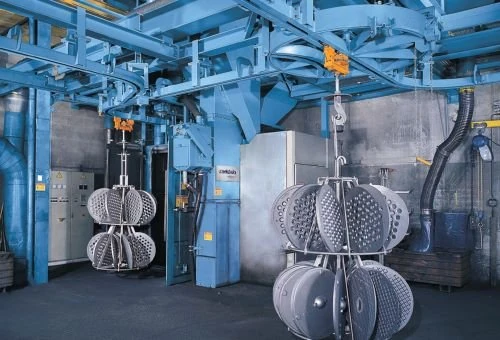
A hanger shot blasting machine suspends workpieces on a rated hook or fixture and moves them through an abrasive-blasting sequence. It can be evaluated when tumbling contact is unsuitable or suspended handling fits the part. Coverage and surface quality still require representative testing.
Workpiece Handling and Exposure
Review the complete suspended load, fixture strength, center of gravity and permitted movement. Parts must remain secure throughout loading, transfer and processing. Suspension requires suitable tooling; it does not mean fixtures are unnecessary.
Rotation or oscillation changes exposure to the blast. Recesses, overlapping parts and fixture contacts can remain shadowed. Do not assume that rotation guarantees complete surface cleaning.
Configuration Features to Define
| Area | What to confirm in the proposal |
|---|---|
| Hook and transfer system | Rated loads, travel, clearance and loading arrangement |
| Chamber | Workpiece envelope, containment and wear protection |
| Blast system | Wheel or nozzle arrangement and qualified exposure |
| Abrasive circulation | Recovery, separation and replenishment control |
| Controls | Operating sequence, adjustments, faults and protective functions |
| Extraction | Capture, collection and maintenance for the actual material |
Hook quantity, rail layout, control brand and component count are configuration-specific. Do not infer that every machine has the same PLC, foundation requirements or monitoring functions.
Assess Application Fit
Castings, weldments and other irregular components may be candidates when they can be safely supported and adequately exposed. Check substrate, contamination, dimensions, sensitive features and the required finish.
Parts that cannot tumble may still be damaged by excessive abrasive exposure or poor fixtures. An industry application list is not proof of supplier experience or product qualification.
Qualify the Surface Result
Agree on cleanliness, profile, residual contamination and dimensional protection. Use representative parts and inspect difficult areas. Record orientation, spacing, abrasive and operating settings.
Cleaning is distinct from controlled shot peening. Claims about fatigue performance require an appropriate qualified peening process and supporting evidence. A cleaning machine should not be sold as providing an automatic strengthening result.
Compare Handling Alternatives
Compare suspended handling with table, conveyor and tumbling arrangements using the same product mix. Review loading, contact areas, changeovers, throughput boundary and maintenance. No arrangement is universally superior for all flat, delicate or complex parts.
Double-hook or automated transfer can alter the work sequence, but actual output depends on the whole cycle. Do not assume a fixed labor saving or removal of all uncleaned zones.
Plan Installation and Technical Support
Confirm structural support, foundation or anchoring requirements, lifting, utilities, extraction and access. A “no pit” configuration does not necessarily mean no civil or structural work.
Request drawings, operation and maintenance instructions, parts lists, training and written support terms. Identify responsibility for integration and acceptance. Additional data or robot interfaces need a defined scope and review of protective functions.
Maintain the Approved Configuration
Inspect lifting and suspension components, wear parts, abrasive flow and extraction according to documentation and duty. Use the specified checks for guards and interlocks. Isolate hazardous energy and secure loads before maintenance or internal access.
Avoid universal replacement intervals or unsupported claims of unlimited customization. Record condition and corrective work, then verify the relevant functions before release.
Agree on Acceptance
Document the intended workpieces, fixtures, settings, inspection and limitations. Use factory and site checks appropriate to the supply scope. A useful technical-support plan explains how the installation will be maintained and verified without relying on invented customer projects or guaranteed coverage and productivity results.
Hitech Hanger Configuration: Define the Complete Suspended Load
| Batch envelope Ø × height (mm) | Selected hook load class (kg) | Blast wheels × motor power (kW) |
|---|---|---|
| 700 × 1200 | 600 | 2 × 7.5 |
| 1000 × 1600 | 800 | 2 × 11 |
| 1200 × 1800 | 1000 | 2 × 15 |
| 1400 × 2200 | 2000 | 3 × 15 |
These paired configurations support initial selection. Confirm the complete suspended load, including fixtures, the swept rotation envelope and the hook/hoist rating. Final supplied configuration follows the workpiece and handling review; this table does not establish batch output or a treatment cycle.
Specify the working system, not only the chamber
Coordinate hook transfer and rotation with wheel position, abrasive feed, chamber liners and seals. The recovery screw, elevator, separator and storage hopper must suit the selected abrasive and duty. Extraction, door interlocks and control sequence form part of the agreed machine configuration.
Which details should accompany a support enquiry?
Send machine and wheel identification, a fixture drawing, loaded mass, representative part dimensions, abrasive grade and the symptom or requested change. Record the current recipe and maintenance condition before changing rotation, abrasive flow or blast time.
Review the engineering inputs or request a Hitech hanger configuration.


