
Dust removal in a sand blasting room is a system-design and operating-control issue. Selecting a collector is only one part of it. The room, air movement, abrasive recovery, operator position, discharge arrangements and maintenance procedures must be assessed together for the actual work.
Clear visibility is useful for operation, but it does not prove that airborne exposure is adequately controlled. Compliance and protective-equipment requirements need a site-specific assessment.
Identify What the Dust Contains
Review the abrasive, substrate and coatings or deposits being removed. Obtain relevant material information and assess contaminants before specifying the system. Silica is one potential hazard; the absence of silica in the purchased abrasive does not establish that the process dust is harmless.
Include cleaning, unloading, filter servicing and waste transfer in the assessment. These activities can expose people outside the normal blasting position. Where the collected material presents fire or explosion hazards, obtain a qualified review of the collection and protection arrangement.
Keep the Two System Paths Clear
The paths serve different purposes and may interact through separator ventilation. Abrasive recycling does not replace extraction across the occupied blasting zone.
Specify the Room and Airflow Together
Provide the room dimensions, openings, workpiece envelope, blasting positions and expected operating pattern. Large parts and fixtures can obstruct airflow, so an empty-room arrangement is not enough to establish performance during production.
The ventilation designer should define supply and extraction arrangements, required operating conditions and how performance will be demonstrated. Do not select extraction points simply by placing ducts close to the nozzle without evaluating airflow across the occupied work area.
HSE's guide to local exhaust ventilation, HSG258, addresses design, commissioning, testing and system documentation. These are useful topics for a supplier review; the applicable installation requirements must still be established for the site.
Evaluate the Complete Collection System
| Design area | Questions for the supplier |
|---|---|
| Air movement | How will the specified airflow be maintained with representative parts present? |
| Ducting | How are dust transport, access and inspection addressed? |
| Collector | Is it suitable for the dust properties and loading? |
| Filters and cleaning | What operating limits, monitoring and service procedures apply? |
| Discharge | Where does the air go, and what requirements apply there? |
| Waste handling | How is collected material contained during removal and disposal? |
A cyclone, cartridge collector and bag filter perform different roles depending on their design. Neither a collector category nor a filtration label alone establishes the performance of the complete installation. Do not assume collected air may be returned to an occupied space without assessment.
Keep Abrasive Recovery Separate from Exposure Control
A recovery system collects reusable media and separates unsuitable material. Its condition affects the working abrasive and the load placed on other equipment. It does not replace room ventilation or establish that the operator's breathing zone is controlled.
Review screens, separator settings, abrasive carry-out and contamination through the equipment procedures. Assess recycling suitability for the actual media and removed material rather than assuming every abrasive can be reused.
Commission and Monitor Performance
Agree acceptance checks and record the as-installed operating conditions. Establish which indicators operators should check, which faults require stopping work, and how maintenance staff will investigate them. Changes to workpieces, abrasive, ducting or production duty may require reassessment.
Filter pressure readings can support maintenance decisions, but they should be interpreted within the system design. A fan running or a filter-cleaning pulse occurring does not independently prove adequate airflow.
Plan Safe Maintenance and Housekeeping
Use documented isolation and access procedures. Provide a method for filter and waste handling that controls the relevant exposure. Select cleaning methods that avoid redistributing hazardous dust through the workplace.
HSE's abrasive-blasting guidance covers exposure controls, protective equipment, maintenance and training. Apply appropriate local requirements and qualified advice to the actual operation, including respiratory protection and any required health surveillance.
When requesting a dust-removal proposal, supply the room layout, materials, operating pattern and existing equipment information. Require a defined design basis and commissioning scope instead of relying on an unsupported claim of lower downtime, guaranteed safety or automatic payback.
Contact Hitech-China with the application information to discuss a configuration-specific proposal.
| Field | Design basis to provide |
|---|---|
| Room envelope | Largest part plus handling and operator access; actual door openings and loading method. |
| Nozzle duty | Number of simultaneously operating nozzles, media and working pressure; compressor demand follows the selected nozzle package. |
| Recovery | Manual, partial-floor or full-floor recovery considered against media, loading and access. |
| Extraction | Dust properties, room layout, air path, openings and representative workpiece obstruction. |
| Controls / acceptance | Interlocks, operating indicators, commissioning checks, maintenance access and agreed records. |
Identify the Recovery Path and the Dust-Air Path
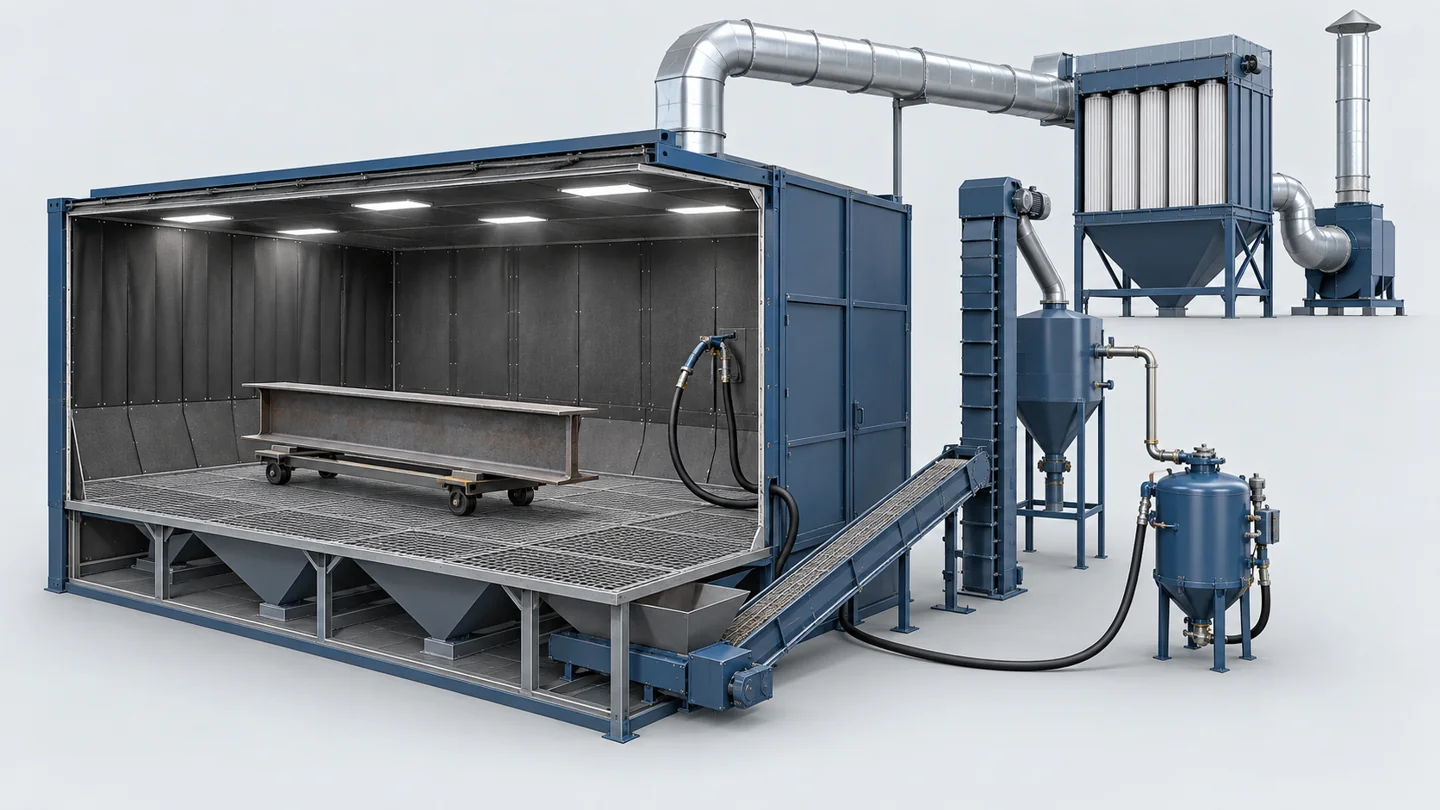
Abrasive path
Spent media falls to the recovery system, passes through separation and returns as an appropriate working mix. Select recovery capacity for abrasive type, collection area and operating duty.
Ventilation path
Air is drawn through the room and ductwork to the dust collector and fan. Room geometry, dust loading, duct losses and discharge arrangements determine the system design.
Check access to both systems before approving the layout. A well-maintained recovery floor does not prove adequate airborne-exposure control.


